







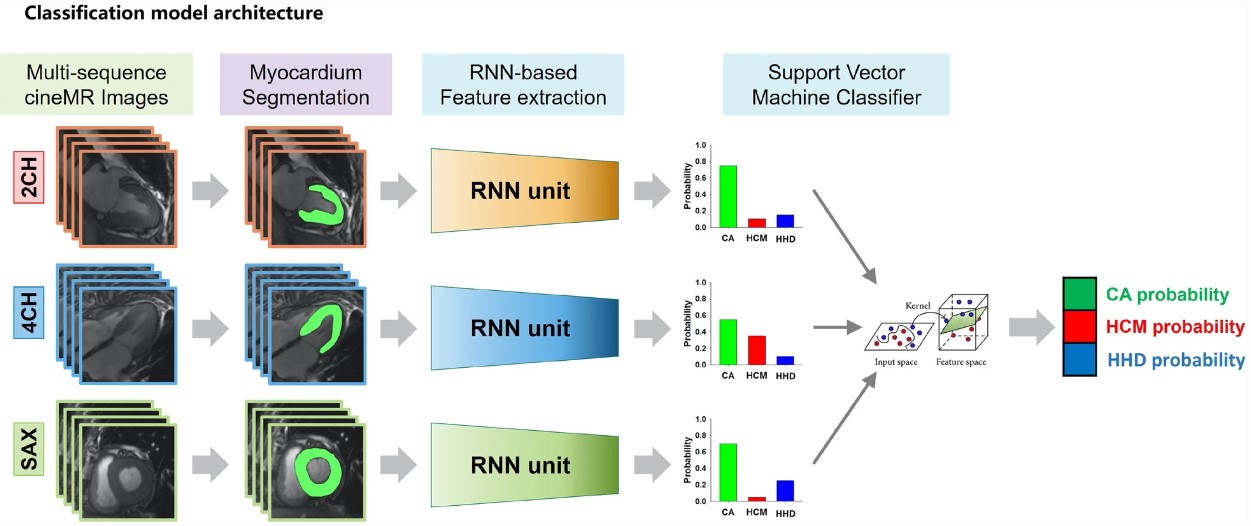
A new study sees the development of a fully automatic framework for the diagnosis of the cause of left ventricular hypertrophy (LVH) via cardiac cine images. The fully automatic myocardium segmentation and spatial-temporal morphology feature-based LVH etiology diagnosis deep learning framework model was able to show a favorable and robust performance in diagnosing the cause of LVH, which could be used as a noninvasive tool, thus helping with clinical decisions.
Key points
- Multi-view cine images provide a potential etiology diagnosis tool for LVH.
- AI-based myocardium spatial–temporal features extracted from images is helpful in diagnosis.
- AI demonstrated higher accuracy and greater robustness with human experience added.
Authors: Kaiyue Diao, Hong-qing Liang, Hong-kun Yin, Ming-jing Yuan, Min Gu, Peng-xin Yu, Sen He, Jiayu Sun, Bin Song, Kang Li & Yong He