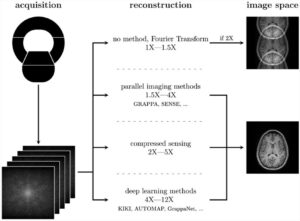










Deep learning reconstruction (DLR) is a novel method of reconstruction that introduces deep convolutional neural networks into the reconstruction flow. The authors of this research examined the clinical applicability of abdominal ultra-high-resolution CT (U-HRCT) exams reconstructed with a new DLR and to compare it to hybrid and model-based iterative reconstruction (hybrid-IR, MBIR). Radiologists analysed and graded results from 46 patients in an attempt to compare the difference between CT images subjected to hybrid-IR, MBIR, and DLR.
Key points
- The potential degradation due to increased noise may prevent implementation of ultra-high-resolution CT in the abdomen.
- Image noise and overall image quality for hepatic ultra-high-resolution CT images improved with deep learning reconstruction as compared to hybrid- and model-based iterative reconstruction.
Article: Deep learning reconstruction improves image quality of abdominal ultra-high-resolution CT
Authors: Motonori Akagi, Yuko Nakamura, Toru Higaki, Keigo Narita, Yukiko Honda, Jian Zhou, Zhou Yu, Naruomi Akino, Kazuo Awai