







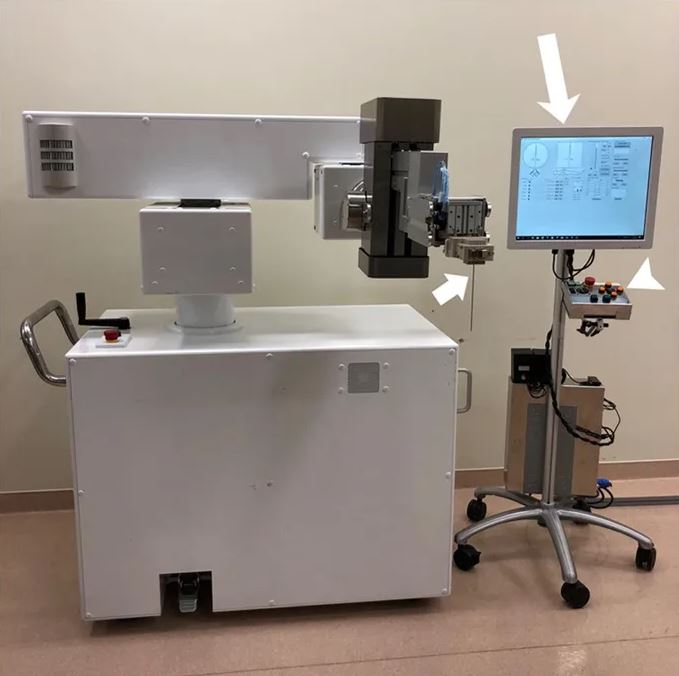
The authors in this study aimed to evaluate the accuracy of robotic CT-guided out-of-plane needle insertion using phantom and animal experiments. A robotic system, Zerobot, which was developed at the authors’ institution, was used for needle insertion. Overall, there were 12 robotic needle insertions which were then compared with the same insertions performed by hand as well as guided by a smartphone application (SmartPuncture). The authors found that the robotic CT-guided out-of-plane needle insertions were more accurate than the smartphone-guided insertions.
Key points
- Out-of-plane needle insertions performed using our robot were more accurate than smartphone-guided manual insertions in the phantom experiment and were also accurate in the in vivo procedure.
- In the phantom experiment, the mean angle errors of the robotic and smartphone-guided manual out-of-plane needle insertions were 0.4° and 3.7° in the XY plane (p < 0.001) and 0.6° and 0.6° in the YZ plane (p = 0.65), respectively.
- In the animal experiment, the overall mean distance accuracies of the robotic out-of-plane needle insertions with and without adjustments of needle orientation during insertion were 2.5 mm and 5.0 mm, respectively.
Authors: Toshiyuki Komaki, Takao Hiraki, Tetsushi Kamegawa, Takayuki Matsuno, Jun Sakurai, Ryutaro Matsuura, Takuya Yamaguchi, Takanori Sasaki, Toshiharu Mitsuhashi, Soichiro Okamoto, Mayu Uka, Yusuke Matsui, Toshihiro Iguchi, Hideo Gobara, Susumu Kanazawa