







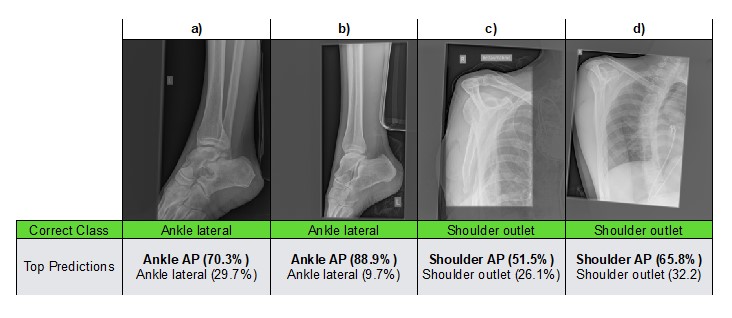
The purpose of this study was to classify the most common types of plain radiography through the use of a neural network and, subsequently, to validate the network’s performance on internal and external data. The authors used data from a single institution when classifying the most common categories of radiographs. This study resulted in the authors determining that it is possible for a single institution to train a neural network to classify the most common categories of plain radiographs.
Key points
- Data from one single institution can be used to train a neural network for the correct detection of the 30 most common categories of plain radiographs.
- The trained model achieved a high accuracy for the majority of categories and showed good generalizability to images from other institutions.
- The neural network is made publicly available and can be used to automatically organize a PACS or to preselect radiographs so that they can be routed to more specialized neural networks for abnormality detection.
Authors: Thomas Dratsch, Michael Korenkov, David Zopfs, Sebastian Brodehl, Bettina Baessler, Daniel Giese, Sebastian Brinkmann, David Maintz & Daniel Pinto dos Santos