








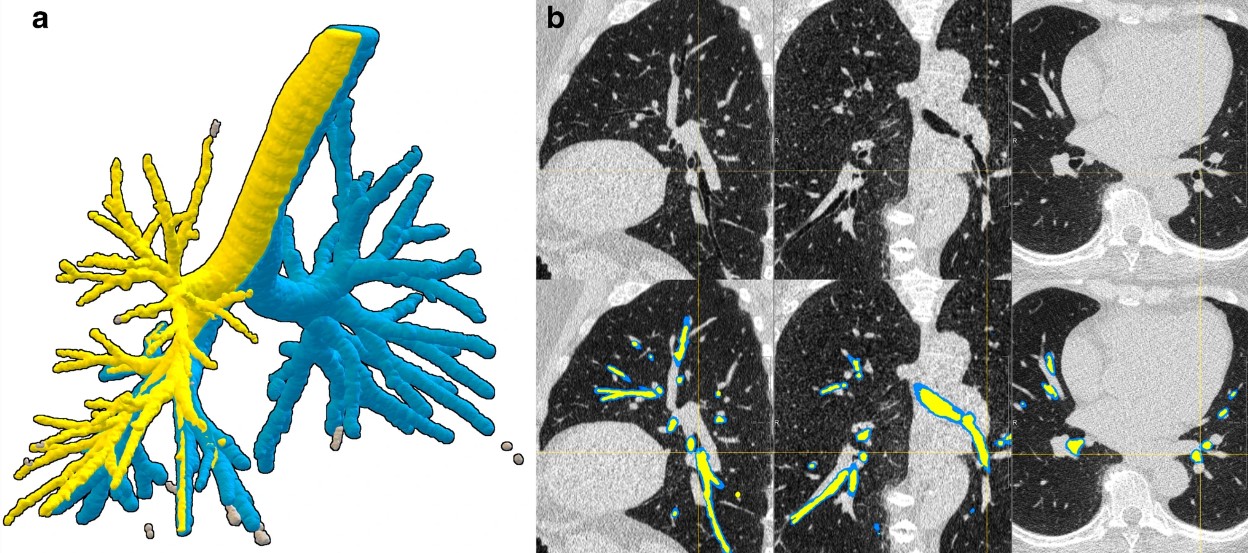
The authors of this study evaluated the reproducibility of a deep learning and optimal-surface graph-cut method to automatically segment the airway lumen and wall, and calculate bronchial parameters. A deep-learning model was trained on 24 low-dose chest CT scans. The study demonstrated a comprehensive and fully automatic pipeline for bronchial parameter measurement on low-dose CT using open-source tools.
Key points
- Deep learning combined with optimal-surface graph-cut provides accurate airway lumen and wall segmentations on low-dose CT scans.
- Analysis of repeat scans showed that the automated tools had moderate-to-good reproducibility of bronchial measurements down to the 6th generation airway.
- Automated measurement of bronchial parameters enables the assessment of large datasets with less man-hours.
Authors: Ivan Dudurych, Antonio Garcia-Uceda, Jens Petersen, Yihui Du, Rozemarijn Vliegenthart & Marleen de Bruijne